Summary by ChatGPT: https://chatgpt.com/s/t_69d288fc647c81918fcd4022eca0d6e1
Чего не хватает на картинке:
-
- интерес;
-
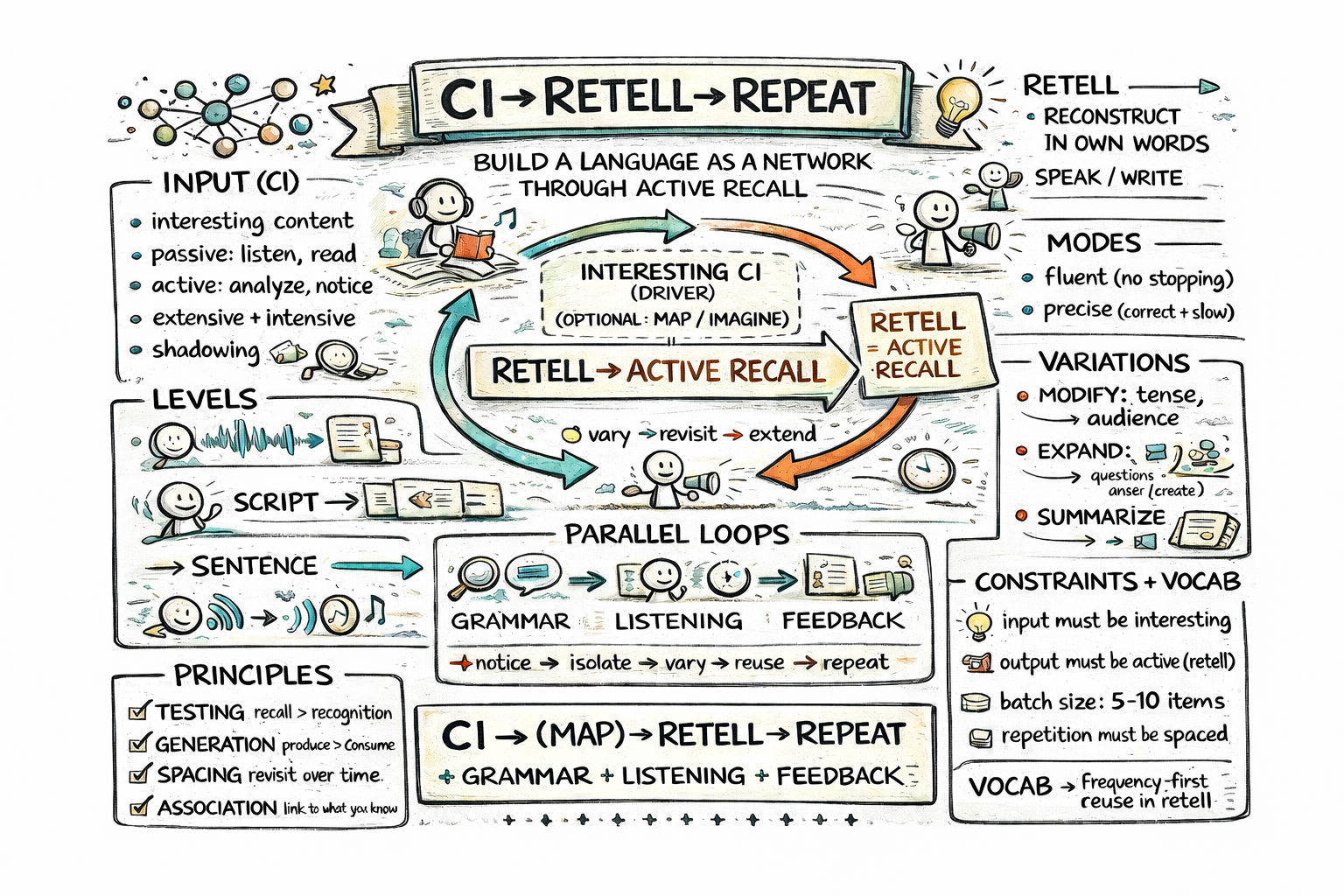
- mapping & retell на всех уровнях. На уровне звуков (и письменности). На уровне слов. На уровне синтагм и предложений. На уровне текстов. На уровне грамматики (системы языка).
-
- forecast/prediction/verification.
-
- multiple loops, actually: retell again with modifications, retell after a while (spaced repetition), retell new stuff.
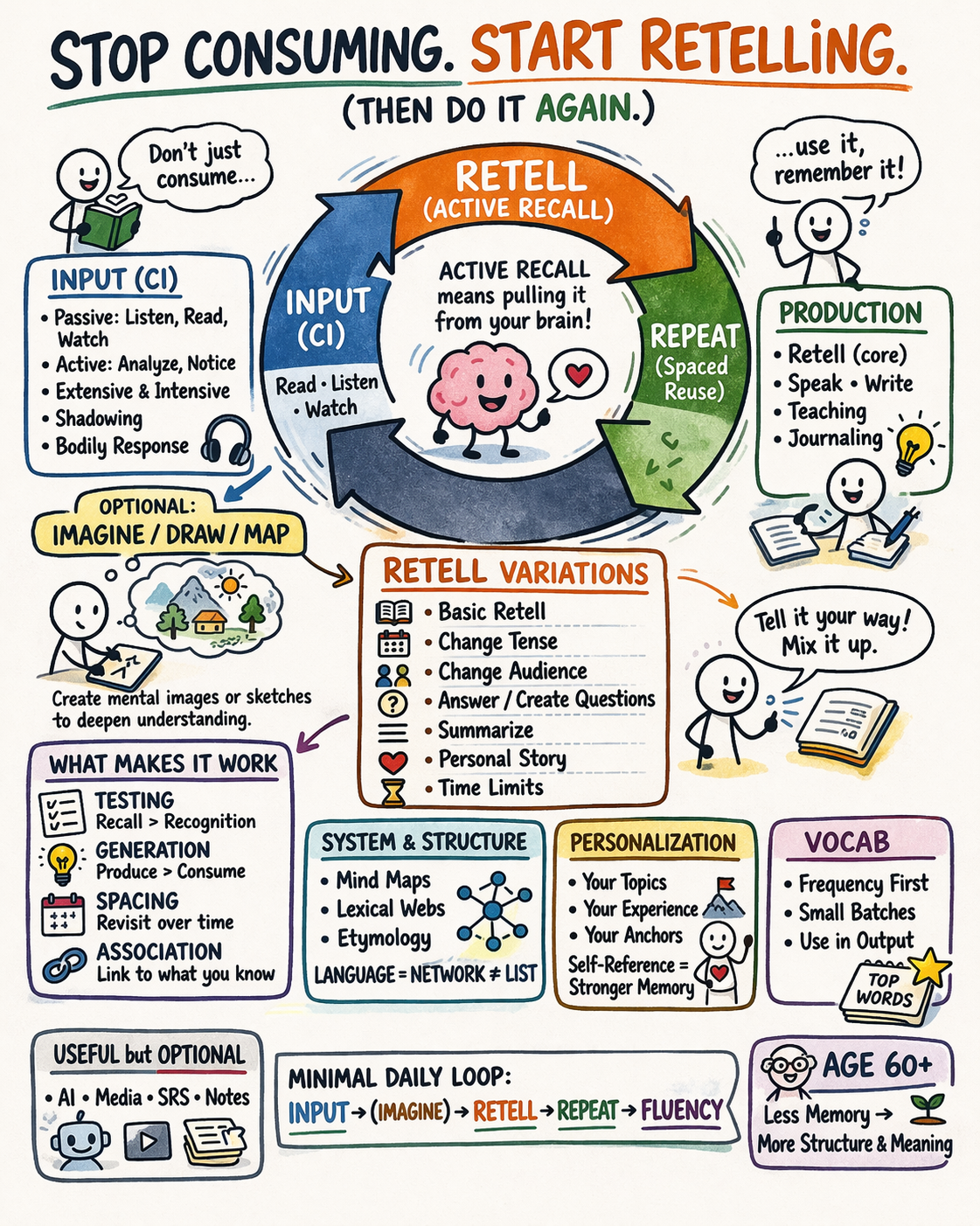
ChatGPT suggested additional loops (valid, IMHO). Just summary: https://chatgpt.com/s/t_69d2fb7fa9f481919dc2e25759775d7a and all the way to combined summary: https://chatgpt.com/share/69d2e71c-8694-8331-b8ec-498601eed0ce
Branching into new chat: https://chatgpt.com/c/WEB:2b6c6604-f3f4-4da0-bf41-f31c1bf40bc4
[Personalization is missing in the picture below:]
Summary/Что пока выстраивается:
- Главное, чтобы нравилось, чтобы было интересно.
- Active & Passive Comprehensible Input (CI) b4 producing (up to B1 or so). Can be generated. + People say that CI may be necessary, but is not sufficient: grammar training etc. is also required. + Disputes over learning vs acquisition of languages, e.g. adults are not children and don’t learn as children do etc. + Duolingo seems to be heavily into acquisition/CI - no grammar, killing explaining forums.
- Active Recall, в том числе: predict/verify [?]; пересказ историй в том или ином формате: с визуализаций и/или кроками, с вопросами, сам пересказ другими словами; с вариациями; с оценкой. Journaling. Teaching. Etc.
A. + ИИ в разных видах (для генерации, объяснения, проверки и т.п.), other tools.
B. + Анки (для меня, скорее всего, не работает). Also, Spaced Repetition in general. Other apps.
C. + Mind Maps/Holistic approach. Web of notions. Система. Этимология/История.
D. + Personalization.
E. + Feynman teaching.
F. + Journaling.
G. + Words by frequency (Eroshev).
【 В моём возрасте (60+): 】много опыта/мало памяти/нужны тяжелые якоря, например, этимология/mind maps/system/personalization.
Tools:
Google Translate History, Google Sheets, Wordwall.
ChatGPT+, NotebookLM, more..
Zettelkasten with Obsidian:
The Zettelkasten method is a note-taking and knowledge management system designed for research and writing, characterized by creating small, interconnected notes (“slips”) to form a “second brain”. Popularized by Niklas Luhmann, it uses principles of atomicity (one idea per note) and constant linking to facilitate new insights and efficient retrieval.
https://youtu.be/Q2zY7l2tzoQ?si-_qprCVhaI1mSWeoe Watch “Zettelkasten Introduction (Simple & Complete Explanation)” on YouTube.
https://youtu.be/d93IdE5Q83g?si-EFX9MjuZinaeeoOS Watch “Feynman’s 15-Minute Trick That Makes Your Brain Absorb Any Language Instantly” on YouTube. Philosophy: Language is a system; brain is a prediction machine. Routine: pick up an interesting subject; predict; verify; re-tell.
Repetitive: interesting subject; re-tell. New: predict/verify. Predict can be considered as a form of Active Recall, I guess..
https://youtu.be/Ys3C23Dk3pE?si-j6OUdnG_OCxPNtAz Watch “Your Brain Has a Language Learning Switch (Do THIS To Turn It On)” on YouTube. Moral: personalize for better memorization (self-reference effect).
A fluent tech with Ivan, Vocab building tutorial. 7 steps. 1. An interesting topic [yes!] Etc. В принципе близко к подходу Бразильского фратера: история с новыми словами; вопросы по ней; надо бы, но отсутствует, пересказ; long term Anki contribution. Неупомнаемый, но присутствующий Active Recall.
Francisco Languages, How to learn languages: 1. Mind athlete approach 2. Don’t produce till B1. 3. Produce @ B1 (or between A2 and B1). Tools: Google Sheets (vocab), Gemini (content), Google Translate.
Alex Air. https://youtu.be/vWLOhBkWH6Q?si-H06knBJsSuFCh0D8 Watch “Get Fluent by Doing This ONE EXERCISE” on YouTube. Retell the story.
How to Do Retelling Correctly:
- Pick a text: Choose a text slightly above your level with 5-10 new vocabulary words or structures (4:43-5:12).
- Read and Highlight: Read the text and highlight words or phrases you don’t know (5:23-5:50).
- Retell the Story: Speak the story aloud, focusing on using the highlighted new elements to move them into your active vocabulary (5:58-6:30).
- Assess and Repeat: Evaluate your performance. If not satisfied, repeat the exercise focusing on better delivery, flow, and fewer fillers (6:30-8:50).
Advanced Modifications: Change the Narrative: Tell the story in a different tense (past/future) or change the audience (e.g., explaining it to a child vs. a professional meeting) (9:48-11:50). Performance Change: Add time constraints (e.g., 10, 30, or 60 seconds) or attempt to tell the story twice as fast while improving quality (12:00-14:50). Tell a Similar Story: Practice responding to conversational scenarios by linking the theme of the text to a similar personal experience (15:09-17:45).
Я бы ещё добавил список вопросов перед пересказом. And active guessing with verification.
https://youtu.be/ZxkWvgbMzgs?si-zXCXwy7rKScUQGAu Watch “Learn ANY language quickly with these Chat GPT Prompts” on YouTube.
Personalized Study Plan (Pareto 80/20) Daily lessons & HW Specifics:
- forvo.com for pronunciation
- videos for listening comprehension
- vocab: most frequent list
- conversation written and oral Weekly tests
Е. Аверина. Зелёная книжечка. https://youtu.be/p8D1HrsPYVQ?si-txZsdgM5LuXSJyD1 Watch “Методика изучения иностранного языка Е. Авериной” on YouTube. https://www.eaverina.com
- Услышать и воспроизвести звуковую последовательность. Пример: повторять вопрос. Потом изменить вопрос.
- Слово вызывает представление. Фиксация текста кроками. Ответить по крокам. Кроки наизусть.
- Слова существуют как система. Лексические карты (пример). Кстати, что-то это мне напоминает… карты, которые делает Gemini… картинки, стрелки на карте. Немые карты.
- По карте учебный текст (носитель начитывает и проверяет). Тексты заучиваются по крокам. Карт так 20-30..
- Иностранный за 200 часов. https://flibusta.is/b/114159
Youglish
YouGlish Spanish (youglish.com/spanish): The direct equivalent. It provides thousands of, if not more, examples of Spanish words in spoken context.
Filmot (filmot.com): A highly recommended alternative that searches for specific words in YouTube subtitles. It is particularly useful because you can filter for videos with manually added subtitles, ensuring high accuracy in matching spoken words to text.
Forvo (forvo.com): A massive pronunciation dictionary where native speakers record words. It is excellent for hearing specific regional accents (e.g., Argentina, Mexico, Spain).
Yarn (getyarn.io): Finds short clips from movies, TV shows, and videos that contain specific phrases, which is useful for seeing the context of idiomatic expressions.
LyricsTraining (lyricstraining.com): A fun, interactive tool that uses music videos to help you practice listening and, by extension, learning how words are spoken in lyrics.
Russell Stannard ….
Большой специалист по Google Translate history, Google sheets, Wordwall etc.
https://adme.media/articles/23-krutyh-sposoba-legko-zapominat-inostrannye-slova-1133060/
Pleasure: e.g. interesting video/book.
ELC and/or self-accountability
Comprehensible Input: active (!) & passive
Listen/shadow/read/write(!)/speak
Read: frontal & slow.
Active Comprehensible Input
Key Aspects of Active Comprehensible Input:
Active Engagement: Rather than just listening, you actively look for patterns, use flashcards for active recall of new words, and summarize content, according to YouTube: Why Comprehensible Input Stops You From Getting Fluent (and what to do instead) and Reddit users.
Interactive Techniques: Methods include shadowing (repeating immediately after hearing), Total Physical Response (TPR) (following commands), and using bilingual texts to instantly verify meaning.
Intensive vs. Extensive: Active CI mixes extensive input (consuming a lot of material for pleasure/gist) with intensive input (taking small, challenging amounts of material and analyzing them deeply).
Feedback Integration: Active learners seek feedback from native speakers or tools to correct their understanding and pronunciation.
How to Practice Active CI:
Shadowing: Listen to audio and repeat it immediately, acting as an echo to improve pronunciation and fluency.
Movietalk: Watch short videos, pausing frequently to describe what is happening or predict what will happen, suggests Sharing Spanish Teacher.
Interactive Reading: Use stories with visuals (e.g., illustrated books) and stop to actively analyze new words in context, say Beyond Language Learning and FabuLingua.
Active Listening: Use tools to listen for specific grammar or vocabulary rather than just playing it in the background.
Active Recall
https://youtu.be/MSq-KGj_cnY?si-N9oPKWKs1s3D7UTD Watch “12 ways to Active Recall in 12 minutes” on YouTube. Active Recall: “Learning doesn’t happen when information goes into your brain — it happens when you successfully pull it back out.” 12 techniques: Before Class: 0:41 Pre-test, 1:19 Stop and Recite, 2:21 In Class: Questions, 3:23 Immediate Review, After Class: 4:29 Toggles, 5:22 Mind Maps, 6:07 Teaching, 7:36 Flashcards, 8:20 Enumeration, 8:48 Occlusions, 9:51 Problem Sets, 10:50 Practice tests.
12 ways to active recall in 12 minutes. Prior: 1. Pretest. Uses hypercorrection (if you fail you remember better). 2. Stop & recite after every section in your own words. During: 3. Write down questions while in class (reverse active recall - you have questions for later). 4. Immediate review (using 3). Going thru the lecture slides. After: 5. Toggles with note making class. Hierarchy of questions, topics. 6. Mind maps/ braindump/ linking. 7. Study groups: teaching/Feynman - teach from memory. Scenarios/roles (child, a nosy person) 8. Flashcards. 9. Enumeration - recall in the same order. 10. Occlusion. 11. Problem sets ASAP. Blueprints. To flashcards. 12. Practice tests (timer etc.)
?? ~ 30 words Listening Shadowing Writing
?? 1,2,3 conj - all forms. (Sounds like a good idea)
Active/passive comprehensible input, no talking
https://youtu.be/qgUIa-Vbxs8?si-eNgrnNSeX3wG-8K2:
Apps:
Shiken (?)
Univerbal (?)
Eggbun (?) Asian
Airlearn
Langua (?)
://Refold.la
Билингвы
Anki pipeline https://youtu.be/QVpu66njzdE?si-UB0OTb-nWCnwSNye
Key Principles of the Feynman Method for Language Learning:
Spacing Effect (2:41): Timed repetition creates strong neural pathways. Instead of mindlessly reviewing flashcards, actively use words in new contexts or create original sentences during each review to transform passive recognition into active creation (3:05).
Generation Effect (4:14): Your brain truly absorbs language when you actively create with it, not just passively listen or read. Force yourself to generate original sentences using new vocabulary by speaking aloud, describing your day in the target language, or writing short paragraphs (4:31).
Testing Effect (6:29): Mistaking recognition for mastery is a common pitfall. Actively recalling information without prompts or context clues creates stronger memory traces. Challenge yourself to produce complete sentences without references, or create flashcards that require generating phrases rather than just translating words (6:35).
Higher-Order Thinking (7:58): Instead of memorizing vocabulary by artificial categories, connect new words to concepts you already deeply understand. Build a web of personal associations to integrate new knowledge with your existing understanding, making it nearly impossible to forget (8:41).
Teaching (9:56): Explain what you’ve learned as if teaching a child. This forces clarity and exposes gaps in your understanding, rapidly consolidating knowledge by requiring you to reorganize information into its most essential form (10:06).
By combining these five principles—spacing, generation, testing, higher-order thinking, and teaching—language learning shifts from frustrating memorization to an integrated experience that helps you become fluent faster (12:08).
https://youtu.be/_IU2ECj-KUo?si-vH2PeTAxzffeh4xu Watch “Quomodo latine loqui cum Sacra Scriptura” on YouTube. Бразильский фратер. Прочитал, нарисовал в голове, построил вопросы, пересказал. Где-то так.
Notebook LM prompts from Carolina:
● Podcasts en español latinoamericano Por favor, habla lenta y detalladamente sobre cada punto tratado en el video, comenta cada punto detalladamente y saca conclusiones sobre cada uno de esos puntos hablando lento. El podcast debe ser total y completamente en español LATINOAMERICANO. Todos los participantes deben hablar lento en español LATINOAMERICANO. El nivel de español debe ser A2, el vocabulario debe ser muy claro y sencillo. Recuerda, español de América Latina nivel A2. Haz un podcast muy pero muy largo y muy detallado hablando despacio. Haz un podcast muy largo y exhaustivo. Debes cubrir absolutamente todos los puntos tratados en el video, no se sebe escapar absolutamente nada.
● Videos en español latinoamericano
Por favor, haz un video largo hablando con voz femenina muy despacio y pausado detalladamente sobre cada punto tratado en el artículo, comenta cada punto detalladamente hablando con voz femenina lento y saca conclusiones sobre cada uno de esos puntos. Asegúrate de dar muchos ejemplos. El nivel de español debe ser A2, el vocabulario debe ser muy claro y sencillo. Recuerda, español de América Latina con voz femenina hablando muy lento. Haz un video muy largo y muy detallado hablando despacio con voz femenina. Recuerda hablar muy lento y pausado con voz femenina. Es indispensable que cubras absolutamente todos los puntos del artículo. Haz un video muy largo y muy detallado, cubre TODOS los puntos. Haz un video larguísimo y exhaustivo.
● Slide Deck en español latinoamericano Por favor, haz un slide deck largo y muy detallado sobre cada punto tratado en el video, comenta cada punto detalladamente y saca conclusiones sobre cada uno de esos puntos. Asegúrate de dar muchos ejemplos. El nivel de español debe ser A2, el vocabulario debe ser muy claro y sencillo. Recuerda, español de América Latina dando infinidad de detalles. Es indispensable que cubras absolutamente todos los puntos del video con muchos detalles. Tienes que cubrir TODOS los puntos. Haz un slide deck detallado y exhaustivo con colores vivos y llamativos.
Идея 💡 : переводить aT на испанский. С целью читать больше на испанском.